Qixing Mountain Via Ferrata: Everything You Need to Know
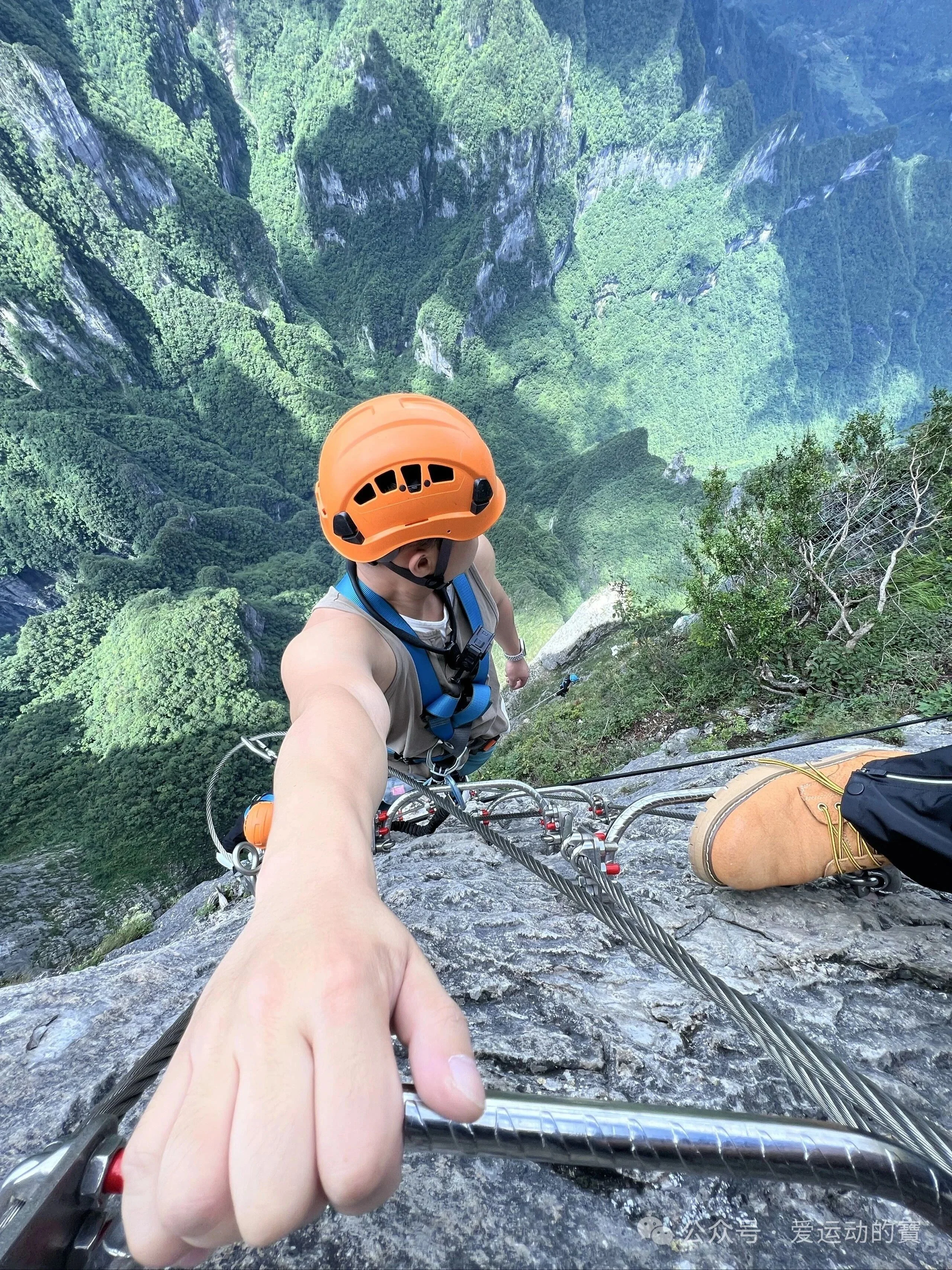
Differences Between Route 1 (Sky Ladder) and Route 2 (Big Wall)
Review the comprehensive breakdown below to decide which route best matches your physical endurance and personal preferences.
| Feature Parameter | Route 1 – Sky Ladder Route | Route 2 – Wansui Big Wall Route |
|---|---|---|
| Overall Difficulty | ★★★☆☆ (3 out of 5 stars) | ★★★★☆ (4 out of 5 stars - Advanced) |
| Route Distance | 1.2 kilometers | 1.1 kilometers |
| Duration | Approximately 3 hours | 3 to 4 hours |
| Main Highlight | 168m Lingyun Sky Ladder (51° incline, 56-floor drop) | Wansui Big Wall overhangs & 80m Monkey Bridge |
| Physical Requirement | Thigh & leg endurance for continuous upward climb | Upper-body & forearm pulling strength for overhangs |
| Age Limits | 12 to 60 years old (inclusive) | Teens 16+ to Adults under 65 years old |
| Recommended For | Beginners, moderate adventure seekers, cloud sea views | Experienced climbers, fit athletes, overhang lovers |
Key Technical Comparison Highlights:
- Route 2 does not include the Lingyun Sky Ladder. Its main challenges are not a long ladder climb, but the overhanging rock face at Wansui Big Wall and the 80-meter Monkey Bridge. These sections require much greater upper-body endurance than Route 1.
- Who should choose Route 2? It is suitable for visitors with previous Via Ferrata or rock-climbing experience, good physical fitness and no strong aversion to cable bridges that sway considerably. It is not recommended for beginners, people with severe fear of heights or visitors with weak upper-body strength.
1. Detailed Introduction to Qixing Mountain Via Ferrata Route 1 – Sky Ladder
1.1 Route Length and Activity Duration
Route 1, also known as the Sky Ladder Route, starts at the top and proceeds downward. The entire route is 1.2 km long and takes approximately 3 hours to complete. It is located at an altitude of 1,480 meters. As an introductory route for beginners, it consists of five sections.
Difficulty rating: ★★★☆☆ (out of 5 stars)
Note: The difficulty ratings are based on subjective experiences within the Via Ferrata industry. The risks mentioned are primarily psychological and physical challenges. The route is equipped with a double-lock lifeline system, so falling accidents will not occur.
1.3 Summary of the Route Sequence
The sequence of Route 1 is:
Big Rock Face descent → Steel Cable Bridge → Small Sky Ladder → Cliffside Hike (Swallow Cave rest stop) → Climb up the Lingyun Sky Ladder → Finish at the endpoint.
1.2 Detailed Introduction to Each Section: Highlights, Challenges and Potential Risks
Highlights: Climb down from the top of the cliff, with a thousand-meter-deep canyon directly beneath your feet. Some short sections feature overhanging rock faces, offering spectacular views of the surrounding mountains and sea of clouds from above.
Challenges and potential risks:
- Descending requires considerable strength from the thighs and arms, and leg cramps may occur easily.
- In overhanging sections, your body may be suspended in mid-air, making it difficult to find leverage. The safety clips may also become stuck.
- Metal footholds on the rock face can become extremely hot under direct sunlight, while sweaty hands may become slippery.
- You need to switch your safety locks frequently throughout the route. If you are unfamiliar with the operation, this may slow your progress.
Highlights: The bridge consists of suspended steel cables without a solid floor. The bridge sways in the mountain wind. It is also an excellent photography spot, with deep canyons on both sides.
Challenges and potential risks:
- The bridge may sway noticeably in strong winds, creating considerable psychological pressure for people who are afraid of heights.
- You can only move sideways in small steps rather than taking large strides.
- The open structure beneath your feet can easily create a sensation of weightlessness.
Highlights: A short, suspended vertical metal ladder that allows you to descend quickly. It serves as a psychological warm-up before tackling the Lingyun Sky Ladder.
Challenges and potential risks: The ladder steps are open, and looking down can create a strong visual impact. The footholds are small, so pay attention to your footing and to switching the safety clips correctly.
Highlights: Walk along a cliffside path and visit the Swallow Cave rock formation. You can stop here to drink water, take a break and recover your strength.
Challenges and potential risks: The path is uneven, and loose gravel can make it slippery. Some sections have a cliff directly alongside the outer edge, so avoid leaning your body too far out.
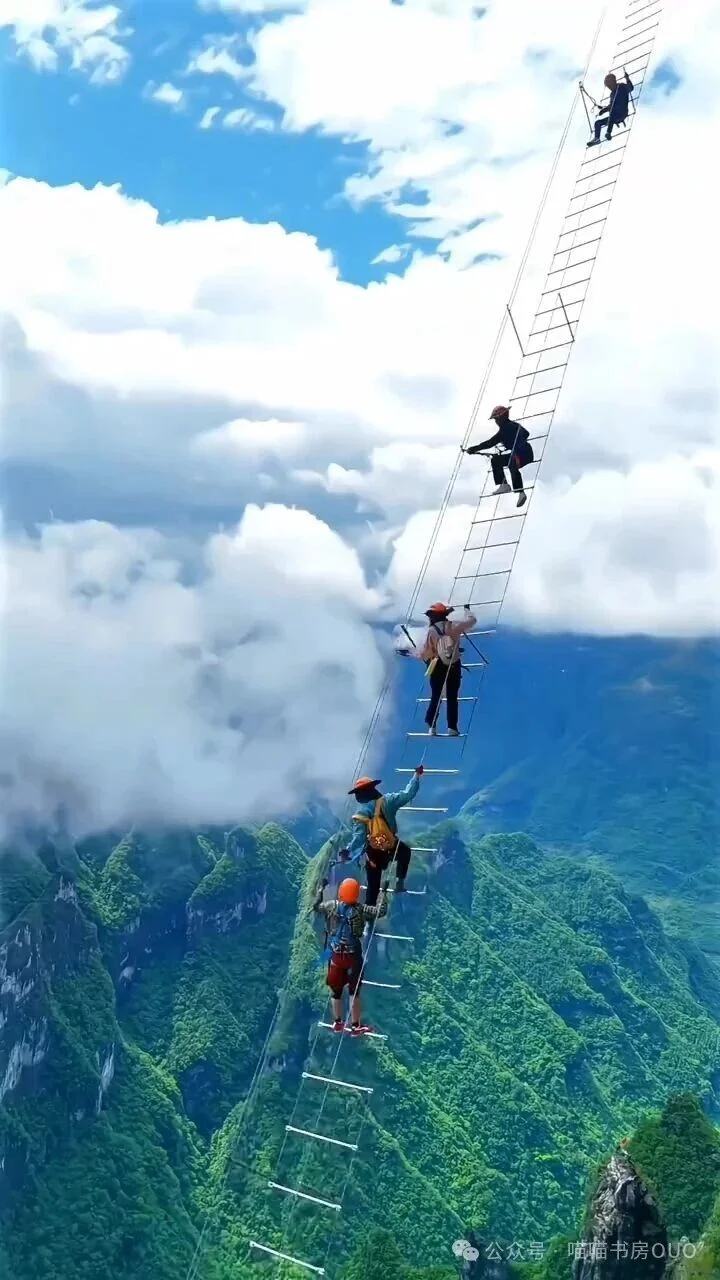
Highlights: A suspended metal ladder with open steps, hanging above a cliff nearly 1,000 meters high. The mountain wind may cause the ladder to sway slightly. As you climb through the sea of clouds, there are no obstructions to the view. On a clear day, you can enjoy spectacular panoramic views of the sea of clouds, deep canyons and surrounding forests. Once you step onto the ladder, you must continue climbing to the top; you cannot turn back halfway.
Challenges and potential risks:
- The entire climb is continuous, with no intermediate platform for resting. Your arms and thighs can become extremely fatigued.
- The ladder steps are open, allowing you to look directly down into the abyss. The psychological pressure can be intense.
- The ladder may sway in strong mountain winds, increasing the sense of tension.
- You must frequently switch your safety locks. Incorrect operation may cause you to stop and delay your progress.
- Under the intense summer sun, the metal ladder can become extremely hot, potentially burning your hands. Wearing gloves is recommended.
Logistics & Participant Requirements for Route 1
1.4 Location & How to Get There: First, enter the scenic area through the ticket checkpoint and take the cable car up the mountain. From the upper cable car station, proceed to the shuttle bus boarding point at Bajiao Pavilion and take the scenic-area shuttle bus to the Via Ferrata starting point. The cable car and scenic-area shuttle bus are already included in the Via Ferrata ticket.
1.5 Operating Hours & Strict Cutoff: Qixing Mountain Scenic Area opens at around 08:00 and the Via Ferrata opens about half an hour later. The Via Ferrata activities, including both Route 1 (Sky Ladder) and Route 2 (Wansui Big Wall), stop accepting participants at 13:00 every day, regardless of the season. Visitors who have booked Via Ferrata tickets must arrive at the equipment station before 13:00 to complete the registration procedures. No further entry or climbing arrangements will be made after this time, and tickets will automatically become invalid if visitors miss the deadline.
1.6 Ticket Prices: The current ticket price for Qixing Mountain Via Ferrata Route 1 (Sky Ladder) is RMB 780. The ticket includes: Admission to Qixing Mountain Scenic Area, round-trip cable car rides, scenic-area shuttle bus transfers, full safety equipment (helmet and safety harness), insurance, and a commemorative certificate and trophy. The ticket does not include gloves, meals or photography services. Route 2 costs the same as Route 1.
1.7 Age, Weight and Height Requirements: The requirements for participating in Route 1 are:
- Age: Between 12 and 60 years old, inclusive. Minors aged 12–18 must be accompanied by a parent.
- Height: At least 1.4 meters.
- Weight: No more than 120 kg.
2. Detailed Introduction to Qixing Mountain Via Ferrata Route 2 – Big Wall
2.1 Route Length, Duration and General Overview
The route is approximately 1,100 meters long, with a base altitude of 1,480 meters and a vertical drop of nearly 1,000 meters below the cliffs. The entire experience takes approximately 3–4 hours.
Overall difficulty: ★★★★☆ (advanced level; requires strong physical fitness and is not suitable for complete beginners).
Unlike Route 1, Route 2 does not include the 168-meter Lingyun Sky Ladder. Instead, its main challenges are the Wansui Big Wall main cliff, several steel cable bridges, a short 90° vertical ladder and the Monkey Bridge.
2.2 Detailed Introduction to Each Section: Highlights, Challenges and Potential Risks
Highlights: As soon as you enter the exposed cliff section, you face a thousand-meter-deep valley. This is where you begin adapting to the mountain wind and the rhythm of switching safety clips.
Challenges and potential risks: Some parts of the rock face may be damp and slippery. Participants may feel nervous at the beginning, and frequent switching between the main and secondary safety clips can make it easy to forget the three-point contact rule.
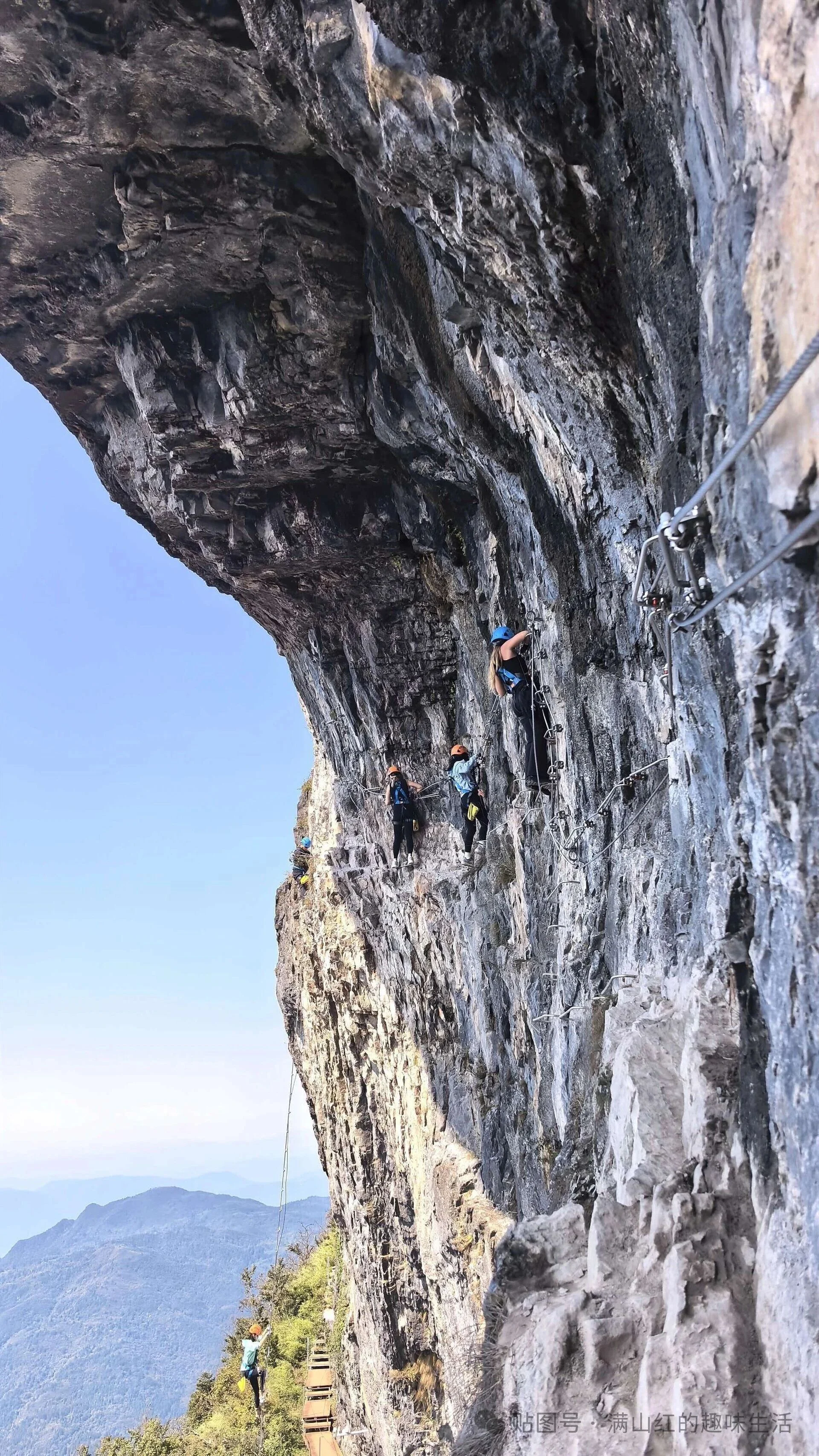
Highlights: A massive exposed cliff with several outward-projecting overhanging sections. Your feet are suspended above a thousand-meter-deep drop, with unobstructed and spectacular views. This is also the section that gives Wansui Big Wall its name. Commemorative inscriptions are carved into a relatively flat section of the rock face.
Challenges and potential risks: Climbing overhanging sections requires enormous pulling strength from the upper body. There are few protrusions on the rock face and limited footholds. In strong winds, the cliff may vibrate, making it extremely difficult to maintain your balance. Sweaty hands can also reduce your grip strength.
Highlights: A narrow steel cable bridge with only steel cable handrails and no solid bridge deck beneath your feet, suspended across the canyon.
Challenges and potential risks: The steel cables sway noticeably, with a larger range of movement in strong winds. You can see the valley directly beneath your feet, which may intensify the fear of heights. Even when you are waiting in line, the bridge continues to sway.
Highlights: This is the longest-span Via Ferrata cable bridge on Qixing Mountain. There are only thin steel cables on both sides for hand support, while a single load-bearing steel cable runs beneath your feet. There is no footboard. You must move your hands and feet alternately, like a monkey, to make your way across.
Challenges and potential risks: The bridge has a large span, and its swaying amplitude is much greater than that of the smaller bridge. Any shift in your center of gravity can easily cause you to swing from side to side. You cannot cross quickly. Participants who have exhausted their strength may become frozen with fear and find it difficult to move while on the bridge.
Highlights: A purely vertical climb, with your body close to the cliff face. When you look up, all you see is the metal ladder; when you look down, there is the abyss.
Challenges and potential risks: The distance between the steps is relatively large. During the vertical climb, much of your body weight is supported by your arms. The exit at the top is narrow, leaving very little room for people to pass one another.
Highlights: After completing the climbing sections, you can look back and enjoy a panoramic view of the entire Wansui Big Wall and the group of cable bridges.
Challenges and potential risks: After several continuous hours of climbing, your upper body and forearms may already be exhausted. Fatigue can cause you to become less attentive to safety procedures. The trail contains a lot of loose gravel, and it is easy to twist an ankle when walking downhill.
2.3 Restrictions and Requirements for Participants on Route 2
Important Information for Participants in the Big Rock Face Via Ferrata Route 2:
- Weight: Less than 120 kg.
- Age requirements: Adults must be under 65 years old. Teenagers must be at least 16 years old.
- Medical Exclusions: Participants must not have heart disease, psychiatric disorders, asthma, epilepsy or other medical conditions for which a doctor has advised against outdoor activities. Pregnant women are not permitted to participate.
- Sobriety & Health: Participants must not have consumed alcohol or taken psychiatric medication within the previous 24 hours. They must also be free from symptoms such as dizziness, low blood sugar or physical exhaustion.
- On-Site Instructor Assessment & Partial Refund Rule: At the Via Ferrata site, instructors will assess participants' physical fitness, blood pressure and other health conditions to determine whether they are fit to take part. If an instructor determines that a participant is not fit to proceed with the activity, RMB 168 will be deducted as a cost fee, and the remaining amount will be refunded in full.
4. Frequently Asked Questions About Qixing Mountain Via Ferrata
4.1 Transportation
How do I get to the starting point of the Via Ferrata?
After entering the scenic area through the ticket checkpoint, take the cable car up the mountain. After getting off the cable car, proceed to the transfer point at Bajiao Pavilion and take the shuttle bus to the 1520 Visitor Center. Transfer to another shuttle bus and get off at Star Picking Pavilion. From there, walk to the Via Ferrata equipment room.
Do I need to pay separately for the cable car and shuttle buses?
No. The RMB 780 Qixing Mountain Via Ferrata ticket already includes the cable car and shuttle bus services within the scenic area. Visitors do not need to pay for these separately. The mountain rail slide at Qixing Mountain is a separately charged activity, but you do not need to take it to reach the Via Ferrata.
4.2 Luggage Storage & Drone Regulations
Is there somewhere to store my luggage?
Ordinary luggage can be stored at the Visitor Center, where smart self-service lockers are available. Suitcases are best left at the Visitor Center service and information desk. At the Via Ferrata equipment starting point on the mountain, where visitors put on their safety harnesses and helmets, there is also a place to store small items. Backpacks, handbags and similar belongings can be left there. Storage facilities on the mountain are limited, so please use the lockers or designated storage areas where available. We recommend keeping valuables and cash with you. All luggage storage locations accept payment by Alipay and WeChat Pay QR code scanning, as well as cash in RMB.
Can I bring a drone up the mountain?
No. Qixing Mountain is located in a no-fly zone. Prior registration with the relevant authorities and official approval are required. Visitors can contact Qixing Mountain customer service to obtain information about the drone application procedure.
4.3 Warm-Up and Preparations Before the Climb
Is the latest check-in time for the Via Ferrata the same as the Scenic Area's latest admission time?
No, they are different. Qixing Mountain Scenic Area starts allowing visitors to enter at 08:00 and stops admitting visitors at 16:00. The Via Ferrata activity starts accepting visitors at 08:30 and stops check-in at 13:00. Completing the entire Via Ferrata route is challenging and takes a considerable amount of time. Visitors must allow sufficient time for the activity. If participants are still climbing after dark, reduced visibility may affect their performance and create potential safety hazards.
What clothing do you recommend for Qixing Mountain Via Ferrata?
- Summer clothing: Wear quick-drying, breathable long- or short-sleeved tops, sun-protective clothing, sports trousers or hiking pants, and thick-soled shoes or hiking shoes. Sunglasses are also recommended.
- Spring and autumn clothing: Wear a quick-drying, breathable long-sleeved top, a jacket, long sports trousers or hiking pants, and thick-soled shoes or hiking shoes. Sunglasses are also recommended.
- Winter clothing: Wear a windproof outdoor jacket, hiking pants, a thick coat, a sweater and thick-soled shoes or hiking shoes. Sunglasses are also recommended.
- Prohibitions: For a better Via Ferrata experience, sandals, slippers, shorts and skirts are not allowed on either Route 1 or Route 2.
⚠️ Important Warning Regarding Wristwatches:
Wearing a watch is not recommended because it may be bumped or scratched, damaging the watch case or glass. The rock faces contain a considerable amount of limestone dust. When your hands and feet rub against the rocks and steel cables, fine dust can be kicked up and settle on the watch case, crown and gaps.
When sweat mixes with the dust, it can form muddy deposits that become trapped in the gaps. Ordinary sports watches are generally less of a concern, but luxury watches are more susceptible to dust entering the case and to scratches on polished surfaces.
Does the scenic area provide gloves?
The scenic area provides safety harnesses and helmets free of charge, but gloves are not included. You can buy or rent gloves at the site for approximately RMB 10 per pair. We also recommend bringing your own durable, non-slip gloves. Gloves are particularly necessary because the steel cables can become hot to the touch in summer, while the rock faces contain dust and small gravel particles.
Can I participate in the Via Ferrata on an empty stomach?
The Via Ferrata requires considerable physical effort. You must eat breakfast (or lunch, depending on your starting time) before setting off to maintain sufficient energy. Participating on an empty stomach is prohibited. Prioritize easily digestible foods that are mainly carbohydrates with a small amount of protein, such as bread, energy bars, steamed buns, warm porridge and a small amount of nuts. Do not climb on an empty stomach, but also avoid eating too much. If you have eaten too much, the swaying and movement on the ladders and cliff faces may make you feel uncomfortable. During the activity, you can carry a small backpack with drinking water, biscuits and other snacks so that you can replenish your energy whenever necessary and maintain enough strength to complete the entire route.
🚽 What is the ONE thing you most strongly recommend visitors do before starting?
USE THE RESTROOM BEFORE STARTING!
The Via Ferrata route runs along exposed cliffs and rock faces. There are no restrooms along the entire route, and it is very difficult to leave the route temporarily once you have started. The activity generally takes 3–4 hours. Having to hold your urine during the climb can be extremely uncomfortable, and nervousness may make you feel an even stronger need to use the restroom. We strongly recommend using the restroom before starting the climb.
4.4 Safety Infrastructure & Emergency Protocols
What safety measures has Qixing Mountain put in place to ensure the safety of Via Ferrata participants? Safety is of paramount importance. To ensure the safety of visitors climbing Qixing Mountain Via Ferrata Routes 1 and 2, Qixing Mountain Scenic Area has established the following hardware facilities and service arrangements:
- Double-Track Steel Cable Lifeline System (Core Protection): Two 12 mm steel cables run throughout the entire route. One serves as the main lifeline, to which visitors attach their continuous self-locking safety clips (double locks). These clips cannot be detached by visitors themselves. The second steel cable connects all the steel footholds and handrails, providing an additional layer of redundancy. Even if you miss a foothold, you will only experience a limited fall, without becoming detached from the main route. The safety equipment includes a full-body safety harness, professional helmet and fall-arrest safety clips.
- Regular Inspections of Anchors and Facilities: The cliff anchors, steel cables, footholds, ladders and other structures are inspected before and after daily operations. Professional load-bearing tests are conducted regularly. Loose anchors are reinforced, aging steel components are replaced, and areas at risk of falling rocks are checked. The project was jointly constructed and inspected with the China Exploration Association.
- Participant Management, Preliminary Screening and Instructor Supervision:
- Pre-activity screening: People with high blood pressure, heart disease or a fear of heights are prohibited from participating. A minimum height requirement is also in place.
- Standardized training: Before departure, instructors teach participants how to switch safety clips, demonstrate the correct movements and explain potential risks. Each participant's equipment is checked individually.
- Instructor supervision: Certified instructors are stationed along the route to supervise different sections, correct unsafe movements promptly and help manage congestion.
- Weather, Lightning and Visitor Capacity Management: The project immediately stops ticket sales and clears the route in the event of mountain thunderstorms, strong winds, heavy rain or dense fog. Lightning protection equipment is installed along the route, and regular lightning protection inspections are conducted by meteorological authorities. Visitor numbers are limited and managed through visitor distribution to prevent congestion along the route.
- Emergency Rescue Mechanism: The scenic area has a high-altitude rescue team and emergency medical supplies. Regular high-altitude Via Ferrata rescue drills are conducted. Emergency shelter points and communication facilities are provided along the route so that stranded participants can be quickly lowered or transferred to safety in an emergency.
- Full-Process Management: A complete management system has been established, covering inspections before operations, supervision during activities and maintenance afterwards. Records are kept throughout the entire process. Regulatory authorities also conduct regular special inspections of the project's facilities, lightning protection systems and safety management.
Important Note: This system can prevent uncontrolled free falls, but risks such as short-distance falls, impacts, falling rocks and physical exhaustion still exist. Participants must strictly follow the instructors' instructions.
Does the scenic area provide safety training before the activity begins?
Yes. Visitors are only allowed to participate in the Via Ferrata after completing the safety training provided by the scenic area. The training lasts approximately 20–30 minutes (taking closer to 30 minutes with large groups). It covers equipment explanation, correct climbing posture, route briefing, emergency procedures, and safety prohibitions. Instructors demonstrate the procedures on site. Every participant must personally practise operating the safety clips on test cables before beginning the climb.
Do visitors put on the safety equipment themselves, or do instructors help them?
Instructors help visitors put on the equipment and conduct a final mandatory inspection. Beginners do not need to put on the equipment independently. The instructor fits your safety harness and helmet, adjusts the straps, and checks every buckle individually before you proceed to training.
4.5 Weather Conditions & Snow/Ice Closure Rules
Can I do the Via Ferrata on a cloudy or rainy day?
- Simply cloudy (no rain, thunder or strong winds): The activity can go ahead. However, dense fog is common on the mountain, and visibility may be very poor, making it difficult to see the distant canyon scenery.
- Rain, drizzle, showers or lightning: The activity will be stopped immediately. Tickets will not be sold, and visitors will not be allowed onto the route. This is a strict requirement because wet rock faces and ladder footholds become slippery, while lightning and falling rocks also pose risks.
- Rapid changes in mountain weather: Mountain weather can change very quickly. Even if it is not raining at the foot of the mountain, rain and thunderstorms may suddenly develop halfway up. In such cases, the activity may be stopped midway, and participants will be asked to wait in place or descend.
- Refund policy on weather closure: Once closed due to rain, visitors who booked Via Ferrata tickets can reschedule free of charge or receive a full refund of the activity fee. (The scenic area admission ticket is non-refundable). Always call ahead to confirm actual conditions on site before setting off—city weather forecasts have limited reference value due to the mountain's distinct microclimate.
Can I do the Via Ferrata when it snows?
In short: When it is snowing, when there is ice, or during freezing rain, the Via Ferrata is generally CLOSED. Icy weather is classified as a prohibited condition under operating rules. Consider three scenarios:
- It is snowing, snow has not been cleared, or rock faces/ladders are covered with ice (Most common): CLOSED. Steel footholds and Lingyun Sky Ladder become frictionless icy surfaces. Slipping can cause severe impact injuries, and gloves freeze stiff. Ticket sales stop immediately.
- Snow stopped, sun melted ice, and staff finished manual snow/ice clearance: Rare Openings. Staff manually clear snow and assess falling ice hazards. Such situations are very rare; physical requirements are extreme and frostbite risks are high. Most snowy climbing videos online show rare exceptions or trial runs.
- No snow at the foot of the mountain, but summit is icy: CLOSED. City temperatures above 0°C may still mean thin ice on shaded cliff faces at the summit. Always rely on morning telephone confirmation with staff.
Under What Specific Winter Conditions Is the Via Ferrata Closed?
- Around 0°C at the summit: Closed if frost or a thin layer of ice forms on rock faces or metal footholds (even if ambient air is +1–2°C).
- At or below -5°C: CLOSED. High risk of frostbite from freezing metal, combined with cliff ice hazards and difficult rescue operations.
- Between 0°C and 5°C (dry, clear, no ice): May theoretically open after on-site staff safety assessment of hand heat loss and wind chill risks.
4.6 Tickets, Booking & Refund Regulations
When is the peak season?
April to October is the main season. Busiest periods include summer holidays (July–August), May Day, and China's National Day holidays (October 1–7). Low season runs from November to March of the following year when ice and fog are more frequent.
Should I book tickets in advance?
We strongly recommend booking in advance! The Via Ferrata is a capacity-controlled activity with a **strict daily limit of 150 participants** across the two routes. During peak season, tickets sell out quickly on site.
Can I get a refund if I cannot participate?
Yes. If you cancel your booking more than 1 day in advance, you will receive a full refund. At the site, if an instructor health assessment determines you are unable to proceed, **RMB 168 will be deducted as a cost fee**, and the remaining amount will be refunded in full.
Are there discounts for children, teenagers or senior visitors?
The Via Ferrata activity has a uniform adult ticket price for all participants. The price is **RMB 780 per person**, regardless of age.
5. What Other Activities Can You Enjoy at Qixing Mountain?
In addition to the Via Ferrata, Qixing Mountain offers four other high-altitude adventure activities:
| Adventure Activity Name | Description & Key Highlights | Duration | Price |
|---|---|---|---|
| 1. Sky Pit Exploration | A 50-meter cave descent followed by climbing out of the cave via a specialized cave Via Ferrata route. | ~1 hour | RMB 380 / person |
| 2. Tianshi Cave Exploration | Includes a high-altitude zipline, steel cable suspension bridge and cave Via Ferrata system. | ~1 hour | RMB 380 / person |
| 3. Cloud Swing | Jump from a platform at an altitude of 1,280 meters, attached to a 160-meter-long swing rope, swinging deep into the canyon. | Per Jump | RMB 280 / person |
| 4. Cliff Flight | Gentle bungee experience: Flight down a canyon with a vertical height of 1,200 meters, followed by a controlled 20m slow descent. | Per Flight | RMB 168 / person |
Ready for Qixing Mountain Via Ferrata?
Due to strict 150 daily capacity limits and the 13:00 PM cutoff, pre-arranged tickets and private transfers are essential. Let our local Zhangjiajie team customize your tour.